

contact@vericarelabs.com

What are THC Isomers?
For many years, cannabinoid testing focused primarily on Δ9-tetrahydrocannabinol (Δ9-THC), the principal psychoactive component of cannabis. However, the modern cannabinoid marketplace has expanded significantly with the introduction of hemp-derived and semi-synthetic compounds, including Δ8-THC, Δ10-THC, HHC, THCP, and other related analogs. Many of these products are produced through chemical conversion of hemp-derived cannabidiol (CBD) and are now widely available in commercial markets.
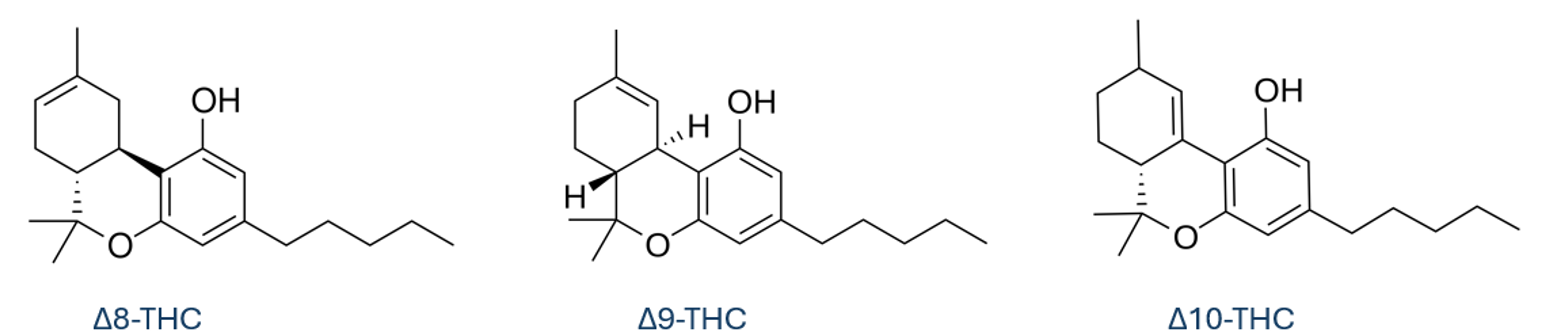
Figure 1. Structural comparison of Δ8-THC, Δ9-THC, and Δ10-THC. These compounds are positional isomers that share the same molecular formula (C₂₁H₃₀O₂) but differ in the location of a carbon-carbon double bond, resulting in differences in pharmacology, metabolism, and analytical detection.
Why is Measuring THC Isomers Important?
As the source of cannabinoid products shifts from traditional cannabis extracts toward hemp-derived formulations, a generic "THC positive" result may no longer provide a complete understanding of an individual's exposure. Different THC isomers can originate from different products and may exhibit distinct pharmacological properties, metabolic pathways, and legal considerations.
The importance of expanded cannabinoid testing extends across multiple specimen types, including oral fluid, blood, urine, and meconium. Recent forensic research has demonstrated that Δ8-THC metabolites can be detected in authentic meconium specimens, highlighting the growing relevance of these compounds in maternal-fetal toxicology and public health.¹ In addition, advanced LC-MS/MS methods have shown the ability to distinguish individual THC isomers that may not be adequately differentiated by conventional screening assays.
Vericare's High-Sensitivity THC Isomer Approach
To address the evolving cannabinoid landscape, Vericare offers an expanded oral fluid THC isomer panel capable of individually identifying and quantifying multiple THC isomers with a cutoff concentration of 2 ng/mL for each analyte. Rather than reporting only a generic THC result, this approach provides greater analytical specificity and supports a more comprehensive assessment of cannabinoid exposure.
As hemp-derived cannabinoids continue to emerge, expanded isomer testing represents an important step toward ensuring that modern toxicology keeps pace with today's increasingly diverse cannabinoid marketplace.
References
¹ Ballotari M, et al. Δ8-tetrahydrocannabinol, Δ9-tetrahydrocannabinol, and cannabidiol carboxylic acid metabolites in authentic meconium samples. J Forensic Sci. 2026.
² Reber JD, et al. An Enhanced LC-MS-MS Technique for Distinguishing Δ8- and Δ9-Tetrahydrocannabinol Isomers in Blood and Urine Specimens. J Anal Toxicol. 2022;46(4):343–352.
³ National Institute of Justice. Cross-reactivity of Emerging Cannabinoid Analogs. 2026.